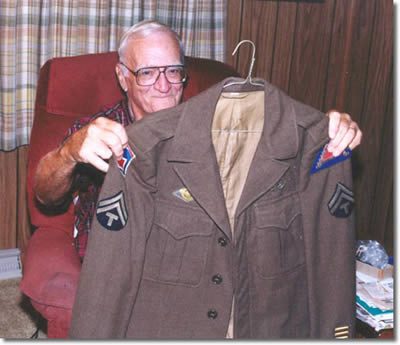
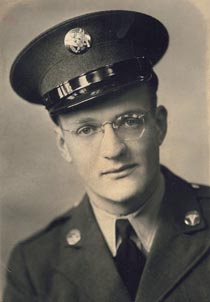
Jack Burrus was a company aid (medic) with a machine gun platoon of the 69th Infantry Division. He began active duty on November 9, 1942, received basic training at Camp Grant in Rockford, IL, and additional chemical lab training at Fitzsimmons Hospital, Denver, CO. He elected to enroll in the Army’s special ASTP training and was sent to the University of Iowa for 9 months of engineering courses. However, the Army cancelled the program (according to Jack, “they discovered that they needed infantrymen worse than they needed engineers”) and he was deployed to Camp Shelby, MS, where he joined the Fighting 69th and completed training as a company aid officer.
On November 15, 1944, he departed New York Habor on the MS John Ericcson, the former Swedish luxury liner the Kungsholm, built by the Germans in 1928. He was a member of Company D of the 272nd Infantry Regiment of the 69th Infantry Division and traveled with the medical detachment to England.
“We were below the water line, which I didn’t care for,” writes Jack in notes he made in 1986 about his years of military service. Not accustomed to sea travel, many of the men became seasick on the high seas. “For two or three days it was a mess. The only ‘safe’ place to ‘feed the fish’ when you felt your food coming up was on the very top deck. Consequently the railing there was always crowded elbow to elbow. On the lower decks, you stayed back away from the rail against the outer walls of the staterooms (officers only) until the very last second. Then you would dash to the rail, feed the fish, and dash back to the wall hoping that the fellow just above you didn’t get the same urge at the same time!”
The division was stationed briefly at Camp Lopcomp near Salisbury, England. Jack obtained passes to visit Salisbury, Winchester and London and was impressed by the British fortitude. “They took a tremendous beating. They were all alone there for awhile. I came away with a lot of respect for them. Boy, they took a pounding. Boy!”
One day he took a taxi ride around London. “The driver took us down near the docks and pointed out one particular area where the Germans had come over with a fire bomb raid one night and burned out dozens of blocks of workers’ homes. He proudly told us that 90% of the workers showed up for work the next morning even though they had lost everything the night before.”
One day, all the battalion medics were asked to help unload a hospital train of casualties from the continent. “We got a quick education of what war is really all about. I helped unload a medic that had been with an infantry company and had a chance to quiz him as to what it would be like when we went ‘on the line.’ He told me that when they first went into France and were up against the regular German army that they pretty much respected the medical insignia (a white circle with a red cross on all four sides of your helmet and a white armband with a red cross — the German medics actually wore a white vest with a large red cross front and back), however if they were up against some of Hitler’s SS troops they seemed to use the red crosses for targets, and it came more prevalent the closer that they came to German territory. He had been machine gunned while treating a casualty and was in a body cast from his ankles to his neck. He gave me a couple bits of advice that I remembered when we went into combat. He told me to smear mud on the red cross on the front of the helmet but leave the others alone so your own men could see you. Then take off the white armband and pin it on the side of your sleeve — again so only your own men could see you.”
On Christmas Day 1944, the division received orders to establish a post at Forges-les Eaux, France. By mid-February, the troops had assembled in areas near Monteneau, Belgium, and awaited orders to relieve the 99th Infantry Division. On February 12, 1945, the Division commanded the entire section known as the Siegfried Line. Through the remainder of 1945, they moved across Germany toward the eastern front, engaging in major offensive battles at Weissenfels and Leipzig.
“The German army breakthrough in the Ardennes forest in Belgium, later known as the Battle of the Bulge, was the final contributor to a ‘blue’ Christmas. [My brother] Chas had already been missing in action for nearly 3 years; my last letter from home said that Dad had been taken to the hospital with what they thought was a heart attack (it later turned out to be bursitis). With the breakthrough, we knew that we would soon be committed to action, and then one night while listening to a German broadcast about the fighting in Belgium, I heard them brag that the ‘glorious armed forces of the Fatherland had totally destroyed the 7th Armored Division.’ That was [my brother] Bud’s division! It was at least 6 weeks before I found out that he survived, but with badly frozen feet.”
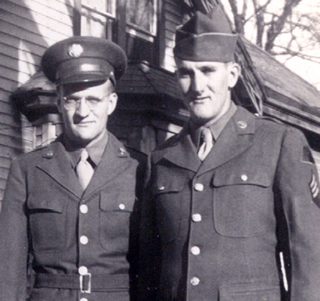
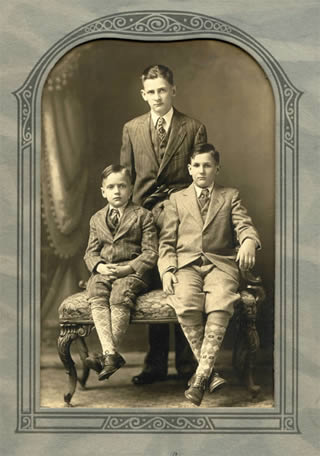
East Meets West
In Leipzig, while some units of the 69th Division were fighting a fierce tank battle inside the city’s rail station, Jack’s unit was held back and ordered to stop where they were — which happened to be right in front of a luxury hotel. “We took it over in a hurry. I swear that the carpets were two inches deep. The beds were great — it was the first time we had been in one for weeks — we had also caught up with running water and electricity. The first thing you do when you take over a place like this is to look for the ‘goodies.’ Somebody found them, too. A whole basement full of stolen French champagne.
“The champagne cache story had an unfortunate ending to it though. When we pulled out the next morning there were bottles of champagne everywhere. I wouldn’t be surprised if we didn’t leave some our machine gun and mortar ammo behind in order to squeeze in a few more bottles in the jeeps and trailers. Everything went along fine for a day or two. Then some GI — I think he was in our anti-tank company — imbibed too much of it and shot his 1st Sergeant. The order came down immediately from the Regimental commander, ‘there will be no more alcohol in any vehicle or on any person from this day forward. Period!’ I can still see one of our Lieutenants emptying a small bottle of Black & White scotch whiskey that he had carried all the way from England for the sole purpose of celebrating VE Day — I’m sure that he had tears running down his cheeks!”
North of Leipzig, one of the patrols of the 69th Infantry went past its assigned route and ended up at Torgau on the River Elbe. On April 25, 1945, elements of the 273rd Infantry Regiment met soldiers from the Russians’ 58th Guard Division at Torgau. The long-awaited link up between the western and eastern fronts occurred, and the troops knew that the war’s end could not be far off.
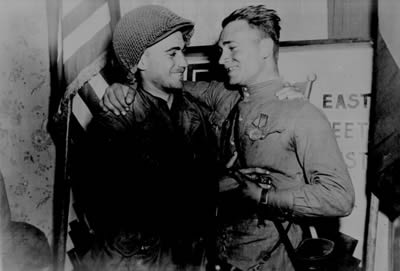
Once the US Army got word about the link-up, official ceremonies to acknowledge the historic meeting were quickly arranged, and several high-ranking generals rolled into town for photographs. “Security was tight when the Generals came to town,” wrote Jack in his post-war notes. “I remember the day that General Hodges, commander of the 1st Army, and Genl. Bradley, commander of the 12th Army Group, came to Torgau. We had riflemen lined up on both sides of the road about 6 feet apart for miles. Don’t know if I had to or not but I got in on the lineup just out of curiosity as I’d never seen a 4-star general before. I’m not sure if we were there to protect them from the Germans or from the drunken Russians.”
Jack wrote a descriptive letter home to his parents about the celebrations that followed:
“To get back to the story of the party, it started when a Russian walked up to me with his hand extended as though to shake hands. Right there’s where I made my first mistake, because I shook hands with him. He no sooner had my hand in a grip like a vise than he promptly slapped his other hand on top of it to apply a little more pressure–just to make sure that I knew he was glad to see me!
About the time I had resigned myself to getting a disability discharge because of a mangled hand, he let go and motioned me into the house where they were staying. My curiosity got the best of me and I went with him. They were just eating. I don’t know what meal it was because it was about 10 o’clock in the morning. He promptly pulled up a chair for me. They didn’t have much. The main course was some highly spiced meat which was really good. They also had some kind of salad made from sour cream and some “brittle” bread. They also had a dish on the table that apparently contained nothing but just plain raw, fat bacon. There was practically no lean in it at all. Although they really devoured it, my curiosity wasn’t quite strong enough to force me to take a piece.
After everybody finished eating they brought out the drinks. I was a little “leery” because I had heard of the potent stuff they carry. However, when they proposed a toast to America and Russia (the only two words I could make out) I decided for the sake of diplomacy to give the stuff a try–that was mistake number two! It looked just like water, but there’s where the resemblance ended! I had heard of liquid fire but that’s the first time I had ever tried drinking it! I decided right then and there that I was never meant to be a diplomat, and that they could take their diplomatic courtesy and politely go to hell!
When I want my tonsils taken out, I’ll have a doctor do it, providing of course that part of my tonsils are left. Now I know why the Russians are such fighters. Just about two shots of that stuff and you’d be ready to fight your own grandmother! When I saw some of the other fellows later, I discovered that I had been to the wrong party. Theirs had ended by one of the Russians passing out 10 dollar bills–or rather 100 Mark notes (occupation money) — guess everybody who was there got one!”